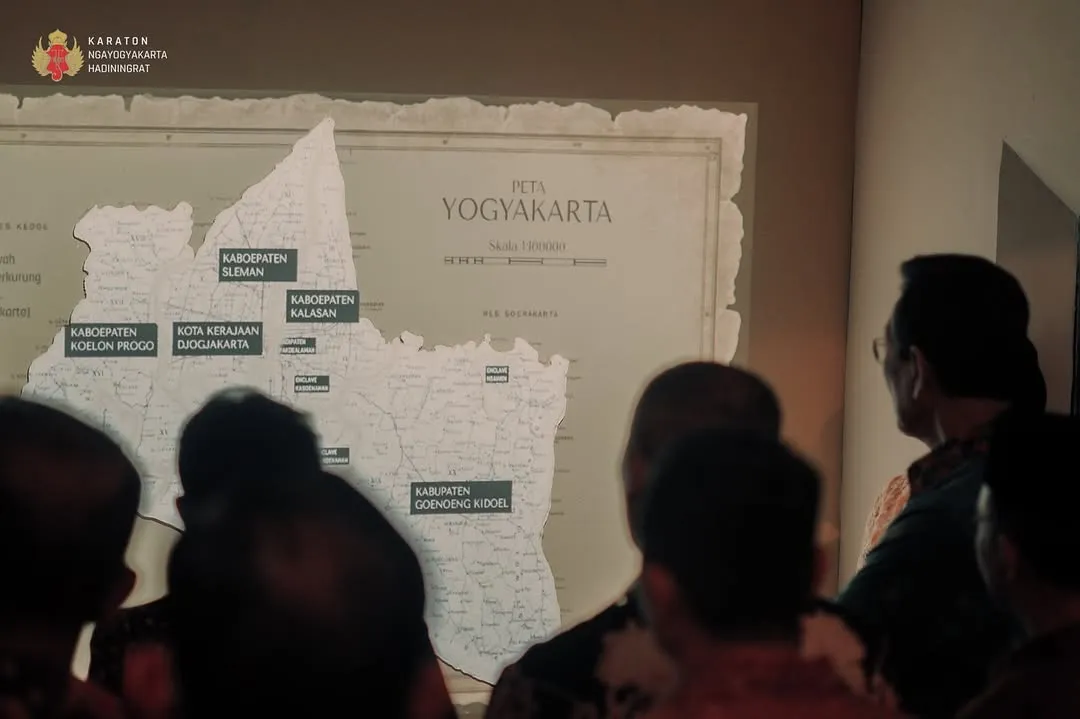
Yogyakarta, as a royal city formed as a result of the Giyanti Agreement (1755), introduced a new system of government administration. This was because Prince Mangkubumi was described in historical literature as a formidable individual. It was not just his military prowess that was tested, but also his social skills, urban planning abilities, and political acumen, which had been proven since he became Sunan Kabanaran. After being crowned as Sri Sultan Hamengku Buwono I, Prince Mangkubumi then organized the royal city as part of the independent territory. Records related to the Sultan's governance can be reviewed in the Babad Ngayogyakarta, Babad Mentawis, and Babad Tanah Jawi.
The journey of Yogyakarta's governance as an open royal city did not always proceed smoothly. Some openness actually sparked conflicts and wars, such as the Geger Sepehi (1812) and the Java War (1825-1830). These two wars provided a complete picture of the complex and concrete nature of Yogyakarta's governance system, which consisted of abdi Dalem and state officials as part of its sovereignty. Following these major wars, the presence of the state apparatus with its complex composition could be observed in major ceremonies. Ceremonies such as the Pisowanan Garebeg, Pisowanan Agustusan, Tedhak Lodji, and the evening banquet held during the reign of Sri Sultan Hamengku Buwono VIII provided insights into the governance structure and institutional framework of the abdi Dalem group at the Yogyakarta Palace.
In one reading of the Tedhak Lodji archives, it was found that the pisowanan ceremony involved Sri Sultan Hamengku Buwono VII and 113 groups of abdi dalem participating in a procession to the residence of the resident every January 1 and August 31. This ceremony was not merely ceremonial but also represented the power of the reigning sultan. During the procession, officials from various regions of Kuthagara and Negaragung were present, symbolizing the sovereign government of Yogyakarta. Based on this data, a simple hypothesis can be formulated that Yogyakarta, as a royal city, was supported by a complex administrative structure tailored to the needs of the government during that period. Referring to historical findings, in 2025 the Yogyakarta Palace held an exhibition titled Hamongnagari: The State Apparatus of Yogyakarta. In this exhibition, the attributes of the government, specifically the state apparatus, were chosen as the main topic to identify the sovereignty of the royal city based on the different periods of the sultan's reign.
Event period
Mar 7, 2025 - Aug 23, 2025
Contact Person Operating Hours
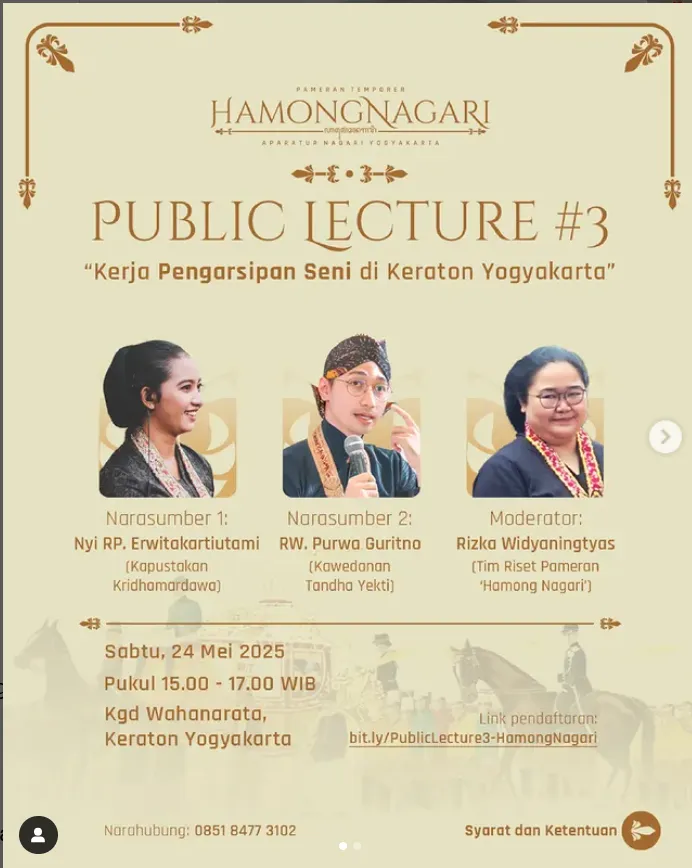
Public Lecture 'Art Archiving in Keraton Yogyakarta'
24 Mei 2025, 12:00
It can be understood together that the performance of art is not only a performance on stage, but also how photo capture or archiving of art can be maintained. Because this archiving is done as a way of history and maintaining collective memory. This performance cannot be separated from the hands of Abdi Dalem who glow in the flow.
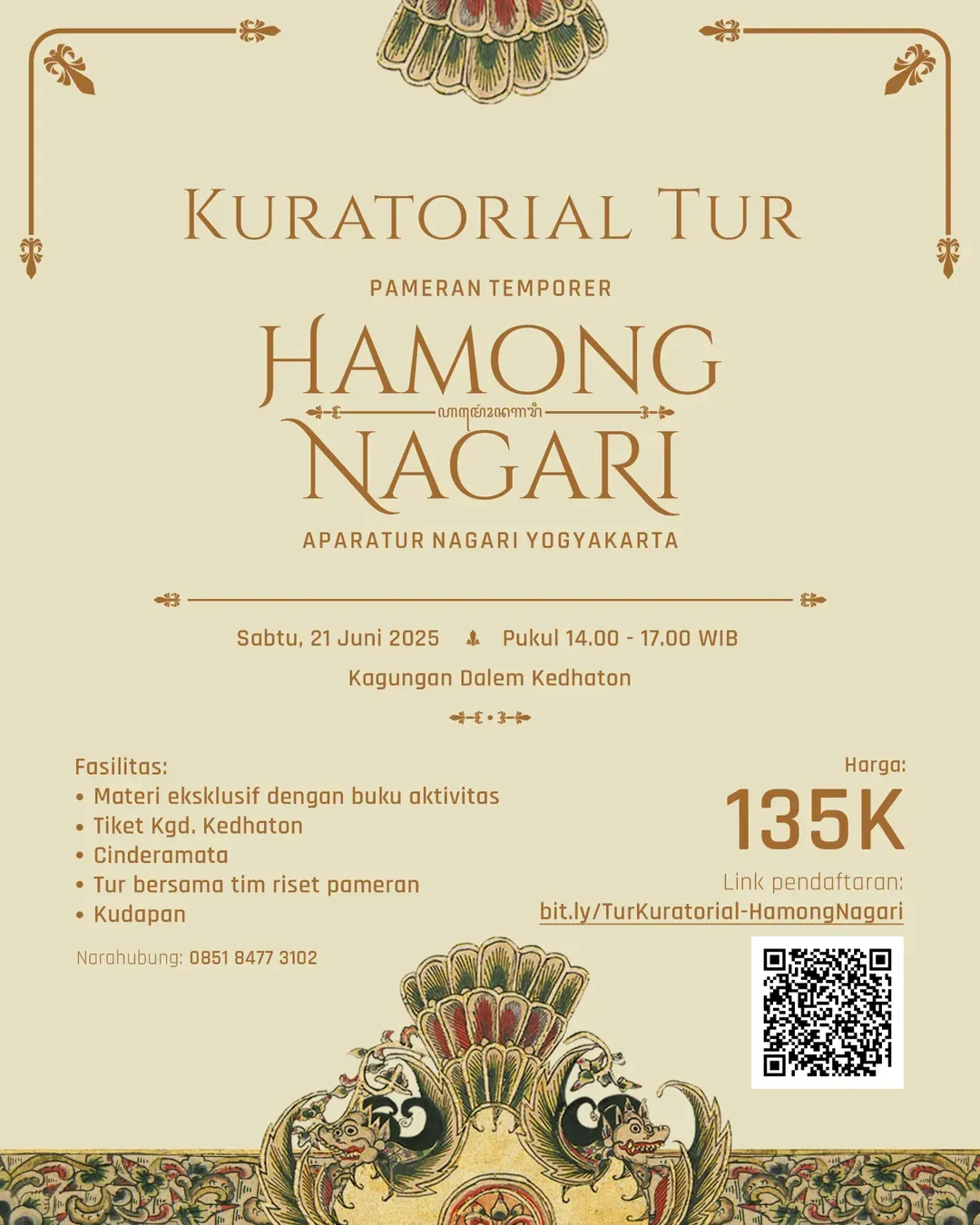
Kuratorial Tur
21 Juni 2025, 12:00
This is an exclusive tour with the exhibition curator and research team to dive into the stories, history and timeline of the apparatus at the Yogyakarta Palace.
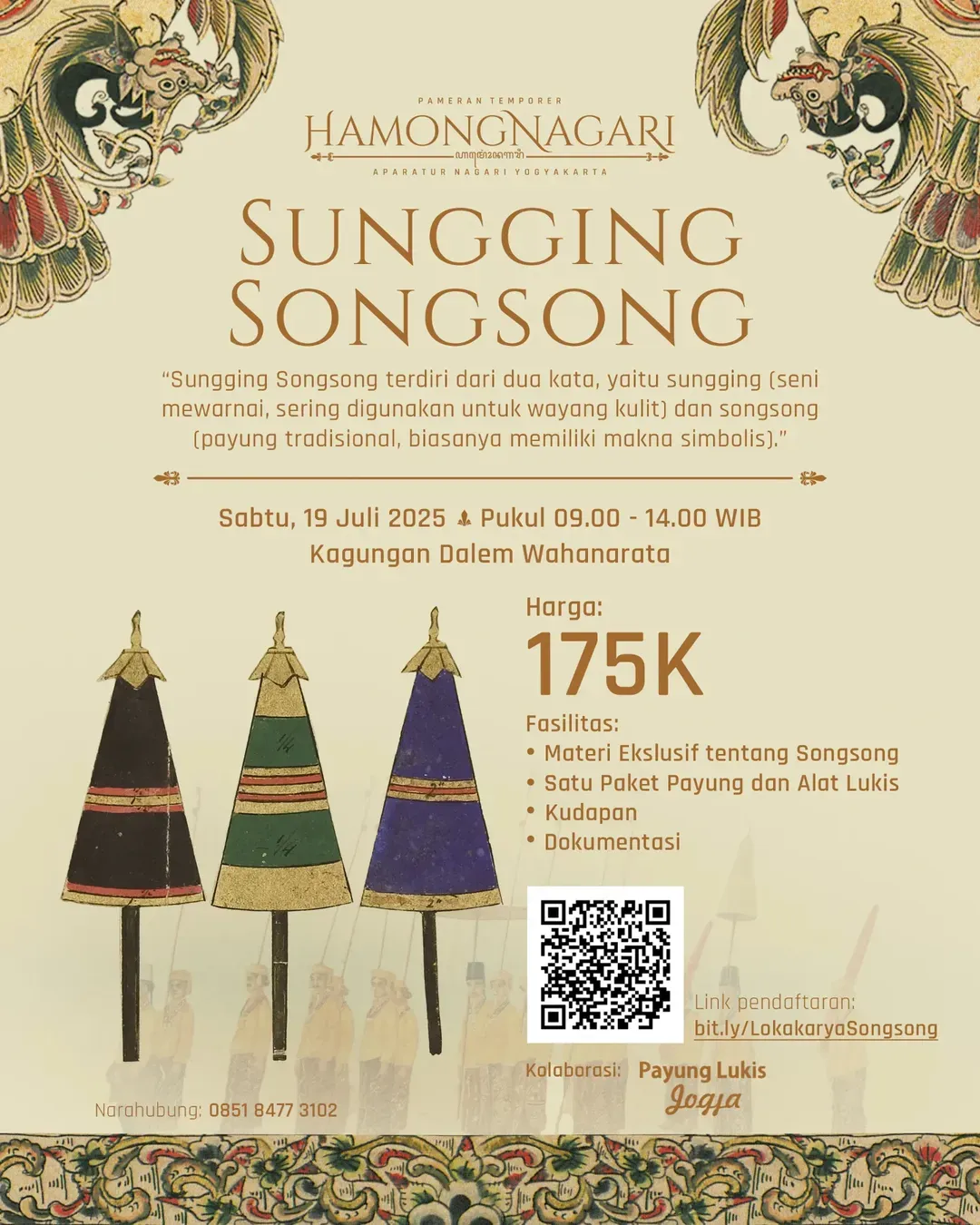
Sungging Songsong
19 Juli 2025, 09:00
“Sungging Songsong consists of two words, namely sungging (the art of coloring, often used for shadow puppets) and songsong (traditional umbrella, usually has a symbolic meaning).”
In this activity, Sahabat @kratonjogja will be invited to remember the history of Songsong in Kraton and other Traditional Umbrellas. Then you will sing (color) songsong according to your own creativity and can take it home.
Translated with DeepL.com (free version)
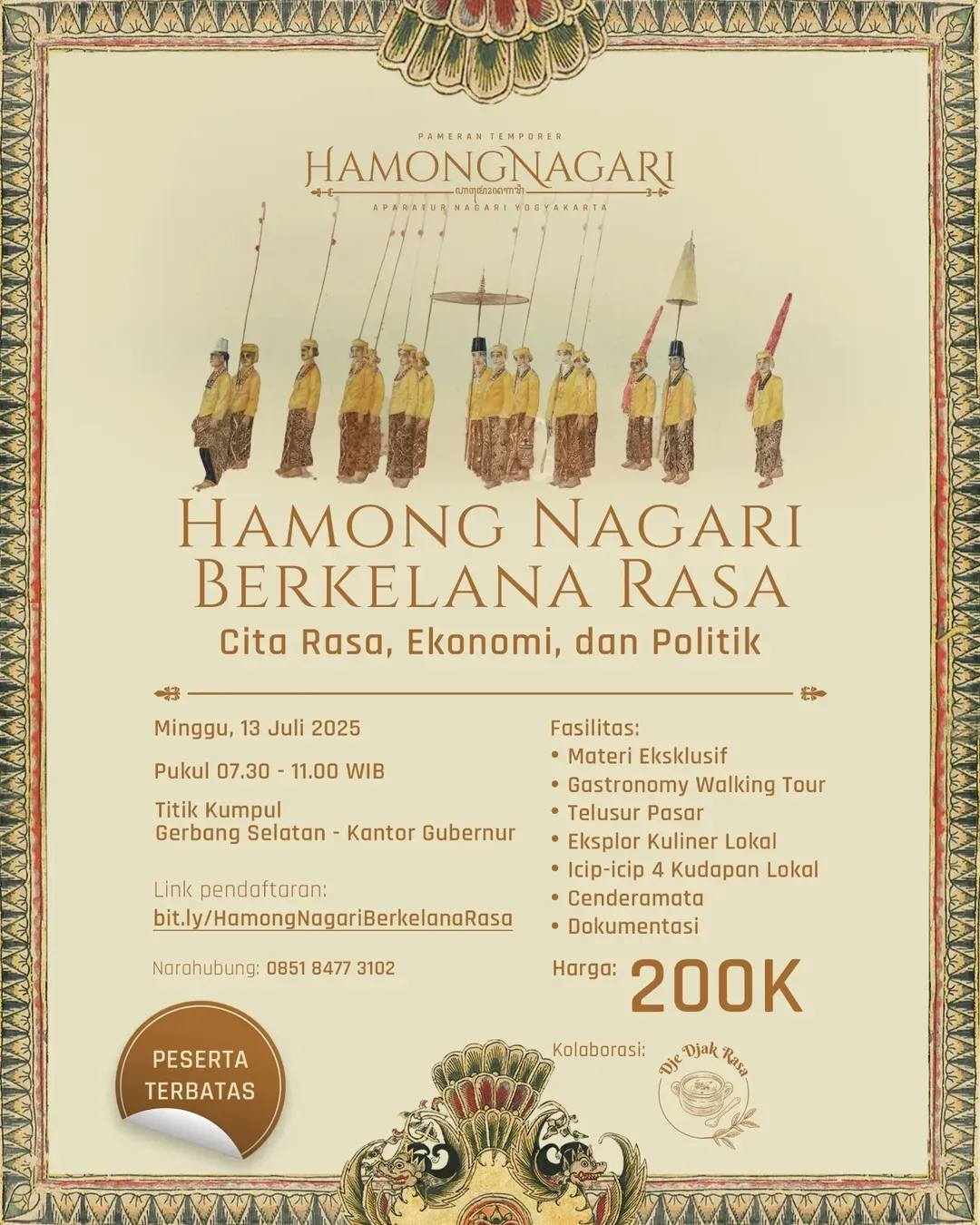
'Hamong Nagari Berkelana Rasa' Politics, Economics, and Taste
13 Juli 2025, 12:00
It can be understood together that the Kraton Yogyakarta glows through various toponyms, economic and political rates. In fact, it all becomes a social line that mutually produces cultural results. One of them is gastronomy. In this agenda, participants are invited to trace every point that accompanies the pace of economy, politics, and taste.